Teton Endurance Mountaineering
Grand Teton Round Trip (PR 3:35)
First Blind Woman Ascent of the Grand Teton (Adaptive Guide assisting Exum Mountain Guides)
Hole Enchilanda (FA 2018)
Wydaho Connection (FA 2018)
Cowboy State Connection with Lewis Smirl (FA 2021)
Teton Infinity Loop (FA 2023)
Grand Teton Bullseye (FA 2018)
Teton Crest Trail- Winter Day Ascent with Lucas Onan (FA 2019)
Grand Teton Round Trip and
First Blind Woman Ascent of the Grand Teton
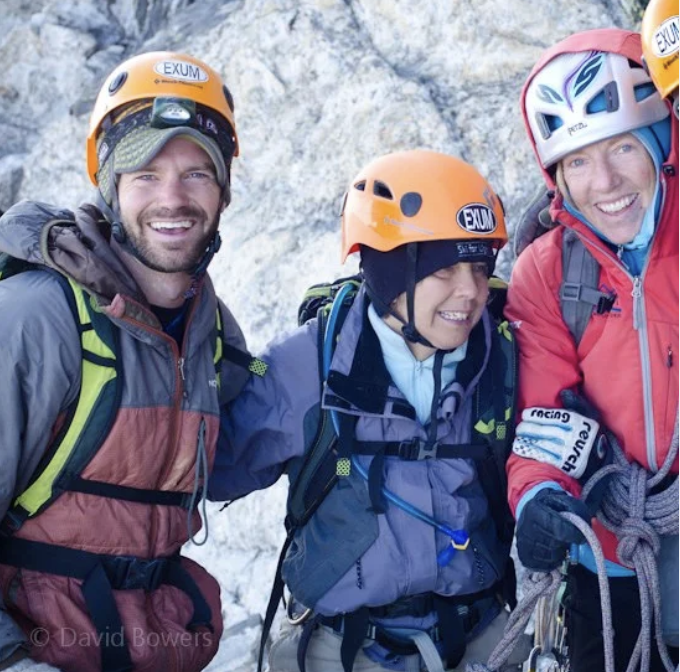
Nancy Stevens, the first and only (so far) blind female climber to summit the Grand Teton. Also pictured Exum Guide Jessica Baker. Brendan Burns and Dana Larkin rounded out Exum team that assisted Nancy on the climb. (Photo by David Bowers)
That summer, we connected a handful of times to run and climb together, and one day I casually mentioned that I thought she could summit the Grand Teton if she ever felt motivated to try. In my mind, that was a five-year goal at best, something that would require significant training and preparation. The next day, she called Exum Mountain Guides and scheduled an ascent for the following summer.
Serving as an assistant on that climb remains one of the highlights of my life. Watching and helping Nancy move steadily through boulder fields, across exposed technical terrain, and higher than she had ever been before all while having no visual reference of what lay ahead fundamentally changed how I approached challenges. From that point on, the excuses I used to make for not trying something difficult felt thin and unconvincing. Her quiet confidence was contagious. Whenever a challenge felt overwhelming, I would think back to her smile on the summit, and my fear would dissolve.
As Nancy became the first blind female athlete to summit the Grand Teton, another record was being set on the mountain that same day. Andy Anderson, a climbing ranger from Colorado, was completing a round-trip speed ascent in 2 hours and 53 minutes. We crossed paths with him high on the route at one of the bottleneck sections. Even moving at full speed and deep into physical fatigue, he took the time to politely ask to pass and offered a smile as he went by. Sharing the mountain that day felt special in a way that’s hard to articulate. Two athletes operating at the edge of their abilities, each in completely different ways, both moving with humility and joy. It was a powerful reminder of what’s possible when people pursue excellence with generosity of spirit.

Andy Anderson on the day of his speed record of 2:53 which still stands to this day
Buoyed by that experience and hungry for a new challenge, I decided it was time to attempt my own speed ascent of the Grand Teton. At the time, FKTs, or fastest known times, weren’t nearly as mainstream as they are today. The idea of running up and down the Grand still felt fringe, which is partly why I was so surprised to see Andy fly past us on the mountain that day. Now, on a dry August weekend, it’s common to see five or ten runners charging uphill and back down at an impressive pace. But in 2012, speed attempts were largely the domain of elite athletes, and I certainly didn’t consider myself one of them. That discomfort was exactly the point. Stepping outside my comfort zone felt like the natural next chapter after spending time on the mountain with Nancy.
That summer, my schedule was packed. I was just beginning my career as a mental health counselor at a local substance abuse treatment center while still wrapping up my responsibilities as summer director for Teton Adaptive Sports. The night before my attempt, I had stayed at a backcountry yurt near Jackson Hole Mountain Resort with three autistic boys. It was meaningful work, but far from restful. I dropped them off mid-morning and arrived at the trailhead around 11 a.m., well aware that midday heat wasn’t ideal. Still, it was the only window I had. In a strangely perfect bit of timing, a friend of mine was finishing his own day on the mountain just as I was starting. He told me the Owen-Spalding route was ice-free and that he’d completed a round trip in about five and a half hours.
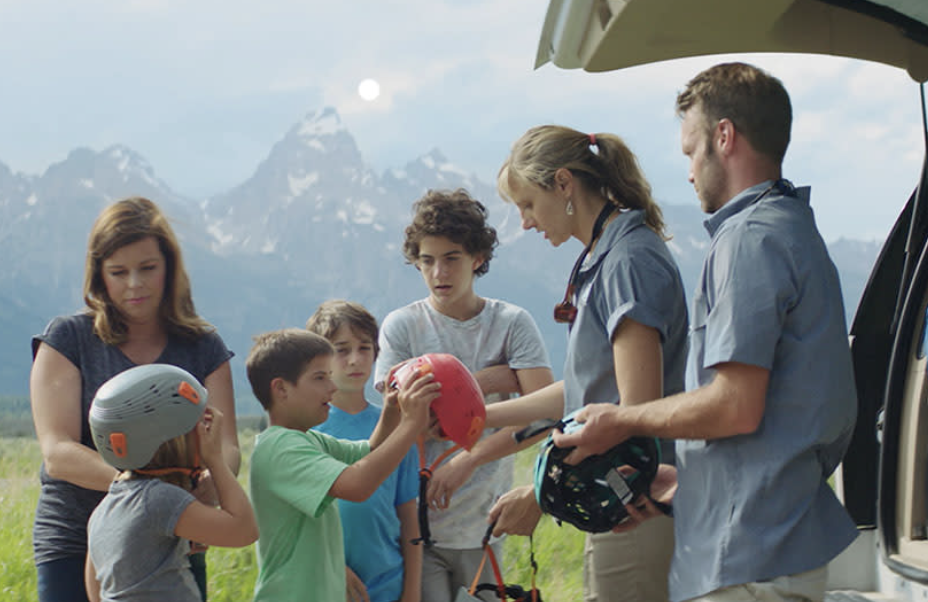
Teton Adaptive Sports: A big part of what made me who I am today
Since I’d never attempted the route at speed, I decided my goal would simply be to match his time and give it an honest effort. I put on some music and headed up the switchbacks, staying right on the edge of having to stop. The climb felt smooth, and I reached the summit in 2:10, exchanged a few high fives, then carefully began the technical descent. I was nowhere near Andy’s record pace, but that didn’t matter. I made it back to the trailhead in another 1:25, stunned to realize I’d completed my first, and ultimately only, speed attempt on the Grand Teton in 3:35. There were no trophies waiting for me, but the experience cracked something open. It showed me that I was capable of more than I had assumed.
I never returned for a second speed attempt. I didn’t think I could go much faster without dedicating serious time to training, and logging that kind of weekly mileage didn’t interest me. Climbing was still my primary passion. But the idea of blending endurance and technical movement began to take shape. That single day planted the seed that endurance mountaineering might be part of my future. A few years later, I began wondering about multiple laps of the Grand in a single day. Without Nancy, Andy, and that first one-day ascent, the idea never would have crossed my mind.
Three Laps of the Grand Teton in a Day
In 2016, I ran Mount Moran and the Grand in the same day, finishing in roughly ten hours. Doing the math afterward, it seemed plausible that three laps of the Grand might be achievable within twenty-four hours. I gave it my first attempt in early summer 2017, but thunderstorms shut me down on my second lap just before the Belly Roll. Even so, I felt strong at the end of the day and knew that if the right opportunity came along, it could happen.
Not long after, I heard about a group planning to attempt two laps of the Grand in a day: two professional runners and a local Search and Rescue member. Wanting to avoid turning the mountain into a competition, I reached out to one of the professional runners, to ask if they’d be open to a fourth person joining their effort. We had met before, though we didn’t know each other well.
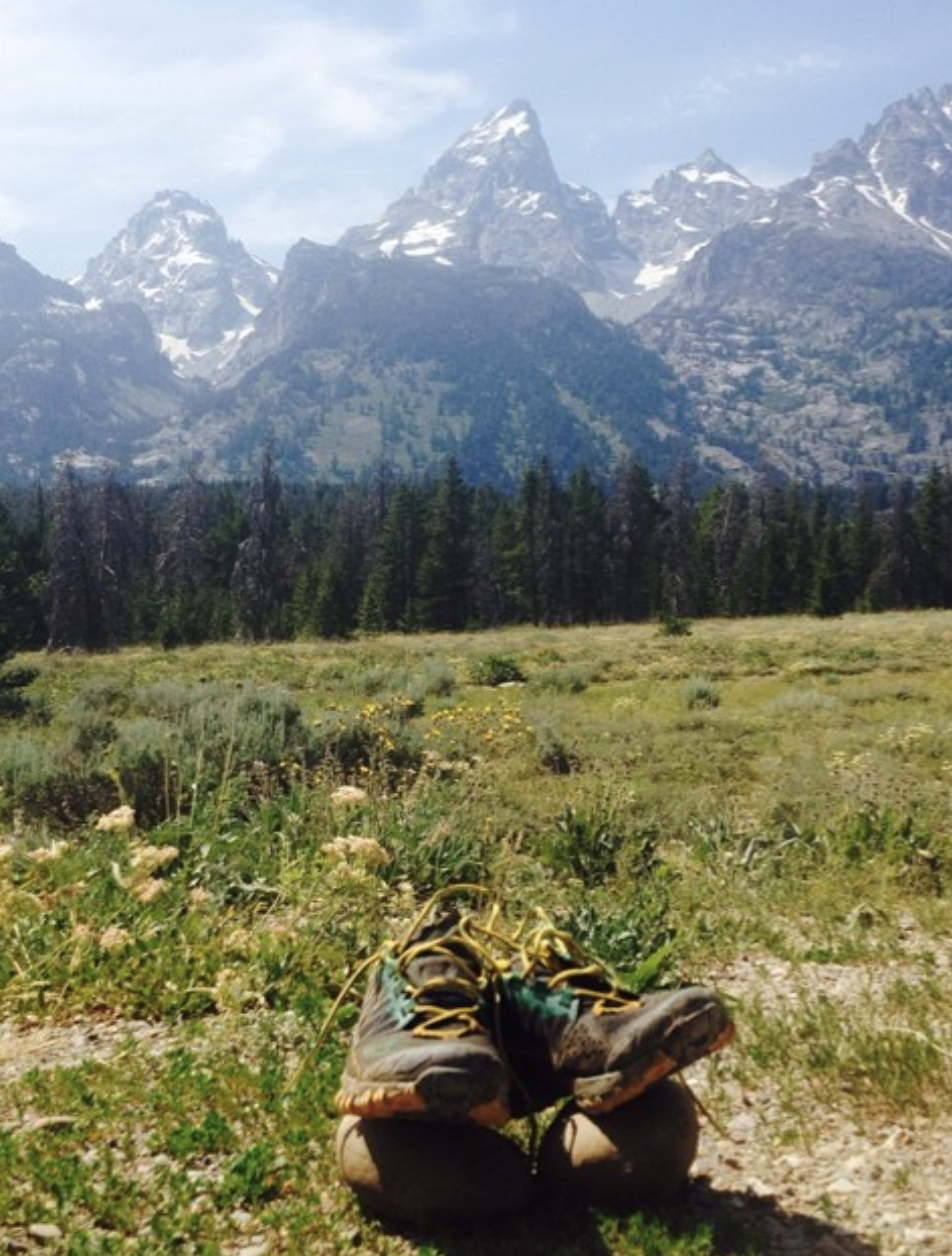
Instagram Photo from day of Speed attempt: 3:35 round trip. Early days of social media content, this is the best I could come up with at the time.
They politely declined, which I fully understood. I would have done the same in her position, not wanting to alter group dynamics. My intention was less about joining them, although I would have, and more about signaling that we were all on the same team, just doing ridiculous things in the mountains for the joy of it. I was concerned that our overlapping objectives, their two laps and my three, might create unnecessary tension. With bluebird summer days in short supply, we ultimately both chose the same date to give it a go.
I learned through a mutual friend about what time they would be starting, so I waited at the trailhead to connect and hopefully set a collaborative tone. Unfortunately, the first member of their group I encountered was upset, accusing me of stepping on their toes. I explained that I’d been planning this objective for a long time and had even asked to join them but was turned down. We eventually shook hands with a basic level of understanding, but the tension lingered as I started up the trail.
Physically, I felt great moving through the meadows, but mentally it was heavy. The last thing I wanted was a race-like atmosphere that might push someone into making a dangerous decision high on the mountain. That concern outweighed my ambition. I turned around and ran back down, meeting their group as they were coming up the switchbacks. They had started later and seemed relieved to see that I wasn’t continuing. I jogged alongside them for about ten minutes, making small talk, still frustrated but trying to keep things light.
That afternoon, I drove to Elephant’s Perch in Idaho to climb with friends. I enjoyed the weekend, but if I’m being honest, I carried a quiet bitterness that my summer objective had been put on hold. The following week, I read about their successful two laps in the paper. They were understandably proud of the accomplishment and speculated that someone might attempt three laps someday. I took that as a gesture of goodwill, or at least an attempt at community spirit. I doubt they imagined someone would try it a few weeks later, but to me it felt like permission.
While waiting for a clear, bluebird day to present itself, I spent a lot of time thinking about the mountain soap opera that had unfolded. The social charades we all perform as humans. On the surface, both their group and myself were playing nice, but underneath it all, neither of us truly wanted to be navigating overlapping ambitions. Sure, either of us could have postponed our objectives, but that doesn’t quite align with the cooperative competition that seems baked into human nature. Social Facilitation Theory suggests that many species, monkeys, rats, vultures, ants, cockroaches, and humans included, perform faster or better in the presence of others. It’s a mechanism that pushes us further than we might go alone. I considered shelving my three-lap attempt that summer, but the human part of me wanted to see what I was capable of. Like the other scavenger species on that list, humans measure themselves against one another, and I wanted to find out what I was made of.
Maybe this wasn’t the noblest motivation, but for these kinds of adventures, you grab onto whatever gets you to the start line. Besting their benchmark wasn’t my only reason, but I did feel a sting reading that they had gone “further than anyone before,” when only lightning storms had stopped me from reaching two laps earlier that summer. I’m aware of how childish this sounds. I was younger and less self-aware then. I hadn’t found a long-term partner, and my testosterone was doing most of the decision-making. Back then, my motivations shifted with every switchback. On one turn, I pushed to impress my dad. On the next, I reminded myself that my body wouldn’t always be this capable and I shouldn’t waste it. Higher on the mountain, I kept moving because I’d just passed a cute girl and suddenly felt inspired to earn a phone number.
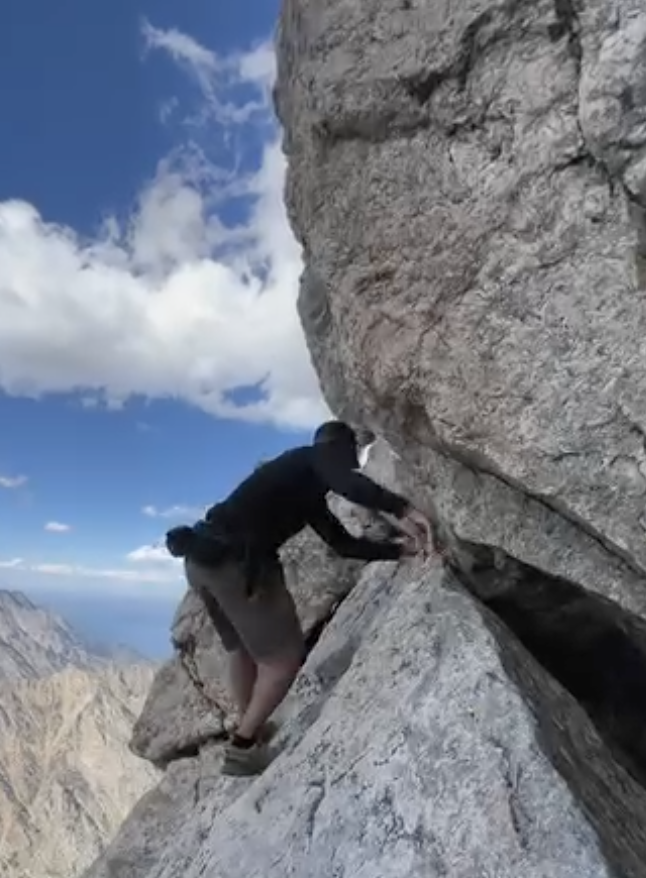
Crossing the Owen-Spalding Route high on the Grand Teton: Big exposure below.
I’m always puzzled when I hear runners or mountaineers in interviews offer a single, polished reason for why they do what they do. Usually it’s framed as pure love of the sport or some tidy philosophy that sounds good in hindsight. For me, when I’m in the trenches, I need a thousand reasons. Any single reason can talk me out of continuing pretty quickly. I have to rotate motivations the same way I rotate songs on a playlist. If one motivation or song stays on too long, I lose interest and quit. Maybe that’s just me, but forward progress has always felt less like devotion to one grand purpose and more like a constant negotiation with the attention span of my own brain.
The day of my attempt was largely unremarkable, except that it had all the necessary ingredients: sunshine, cool temperatures, and just enough people on the mountain to keep my ego engaged. The first lap was pure fun. I slipped easily into a flow state, my legs felt strong, and everything clicked. I passed a few climbing parties who tried to give me directions, which I found amusing, but I smiled, said thanks, and continued on my chosen line. I summited for the first time around 7:00 a.m., with crowds still gathered on the Owen–Spalding. I waited patiently for my turn, reminding myself that I was in this for the long haul, not a sprint.
Running down the Grand Teton is less like running and more like a controlled fall. But once you hit the packed trail, it feels liberating to open up your stride and let gravity do its thing. I finished my first lap in about 4:20, which felt like the right pace if I was going to head back up two more times.
The second lap was disorienting in a way I expected but still resented. Without the novelty of new terrain, the brain starts to push back. It’s like realizing you forgot your wallet after already leaving the house. Annoying, draining, and oddly demoralizing until you pass the point where you turned around. I had to actively redirect my thoughts or risk a full-body mutiny. I focused instead on the expressions of surprise from climbers seeing me for the second or third time that day. Doing laps confuses people. It confuses the brain too. Why do it twice? To which I can only respond: why do it once? None of it has a tangible reward. We go up for the view. So why not go up again?
By the second lap, people looked at me like I was speaking in tongues. Déjà vu mixed with disbelief tends to short-circuit polite social responses. Mouths hung open. Eyes followed me longer than necessary. And oddly enough, that reaction was motivating. Seeing the same people for the fourth, fifth, or sixth time gasp as if I needed immediate psychiatric intervention gave me just enough fuel to keep going.
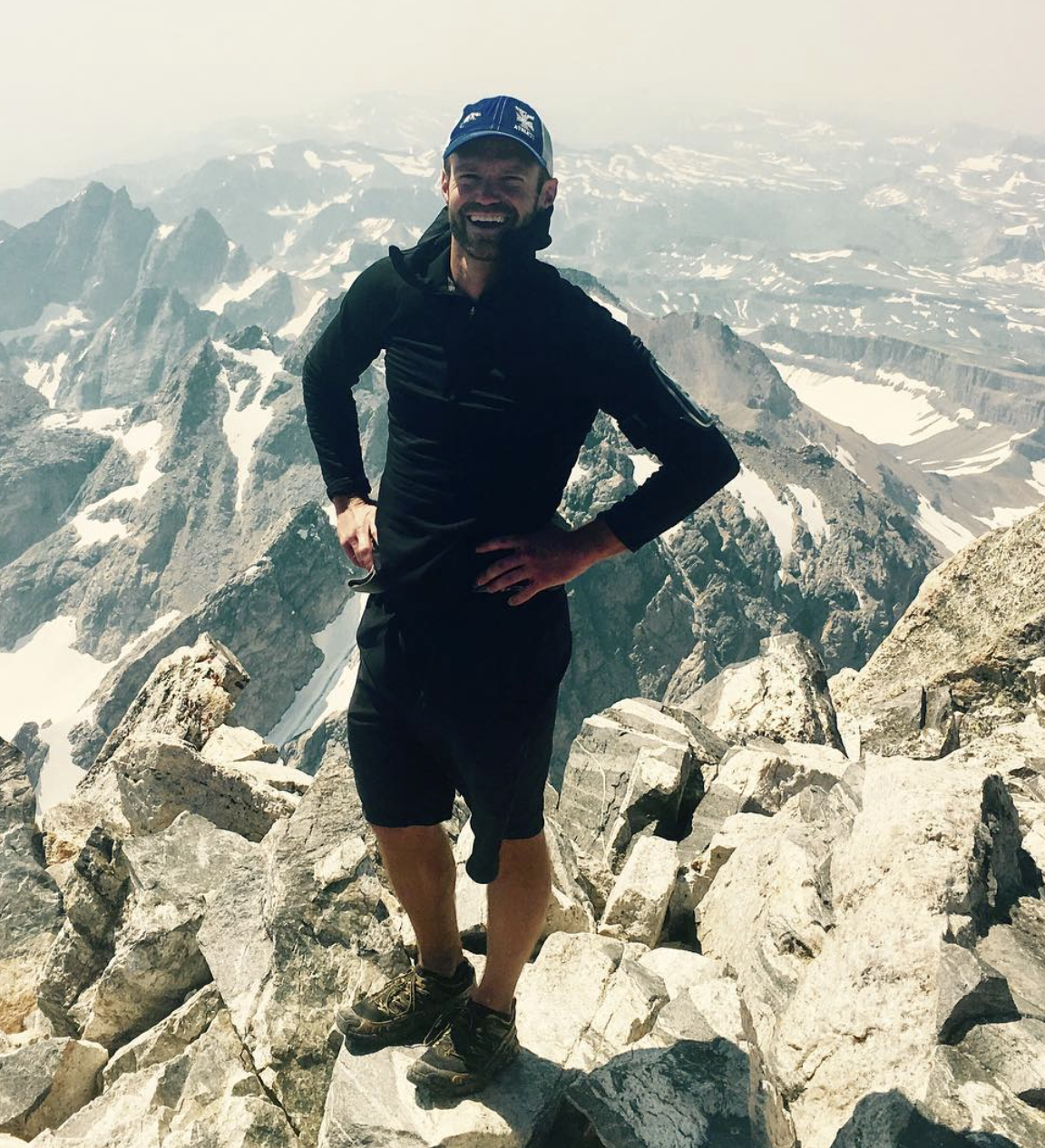
Summit of Lap Two: Smokey weather throughout the day, that didn’t help
I’ll admit it, part of this was ego. I’ve always taken some pride in questioning the dominant paradigm. I sometimes wonder if, had I been born a few decades earlier, I would have had the nerve to pursue first ascents during climbing’s mythic era. I like to think so, but untouched terrain is genuinely terrifying, and I’m far more comfortable extending or connecting existing objectives than stepping onto completely unknown rock. Still, it felt good to stand out. To watch people take a full day, or multiple days, to cover the same terrain I would move through three times in one.
The second lap hurt more, no question. My round-trip time slowed to about 6:12, but in many ways it felt twice as hard. When I returned to the car, my total time sat at 10:32. I was roughly five hours faster than the group who had completed two laps earlier that summer. It would have been tempting to stop there. I had proven what I needed to prove to anyone who happened to notice, which admittedly wasn’t many people. But three laps had always been the goal. Stopping at two never truly entered my mind.
That said, the third lap was no gift. The upper mountain felt like two steps forward and almost two steps back, over and over again. Progress was happening, but it was brutal. Standing on the summit as the sun dipped below the horizon, however, was one of the highlights of my life. There’s something deeply satisfying about setting a goal and staying with it all the way through. All of this mountain tomfoolery is really just life training. It’s a laboratory for testing strength, fear, and internal resilience.
None of it truly matters. And yet, it’s the only thing that does. Can I endure? Can I push through doubt and fatigue? Can I keep going when it stops being fun? The confidence that comes from answering those questions is undeniable. Sure, part of me hoped it might bring status, or admiration, or maybe even a girlfriend. Part of me kept going simply because I had told people I would. But beneath all of that, it came down to keeping a promise to myself. Trying my hardest. On the mountain, and in life.
Somewhere on the descent I found a second, maybe fourth, wind. I ran the final five miles at a respectable clip, finishing my third lap in about 7:22. Not bad for round three. Making my elapsed time for all three laps around 17:54 for 21,000 vertical gain and around 45 miles. There was no crowd at the finish, no high fives, no fanfare. I texted one person to say I was done. Sometimes I feel a twinge of envy when I see athletes welcomed by cheering friends at the end of a big day. I’m sure it feels incredible. But I never wanted to take anyone’s time but my own.
I did this for me. I was supported by strangers on the trail who cheered me on, and that mattered. But at the end of the day, I wanted to know, quietly and without witnesses, that I could do it. And that was enough.